
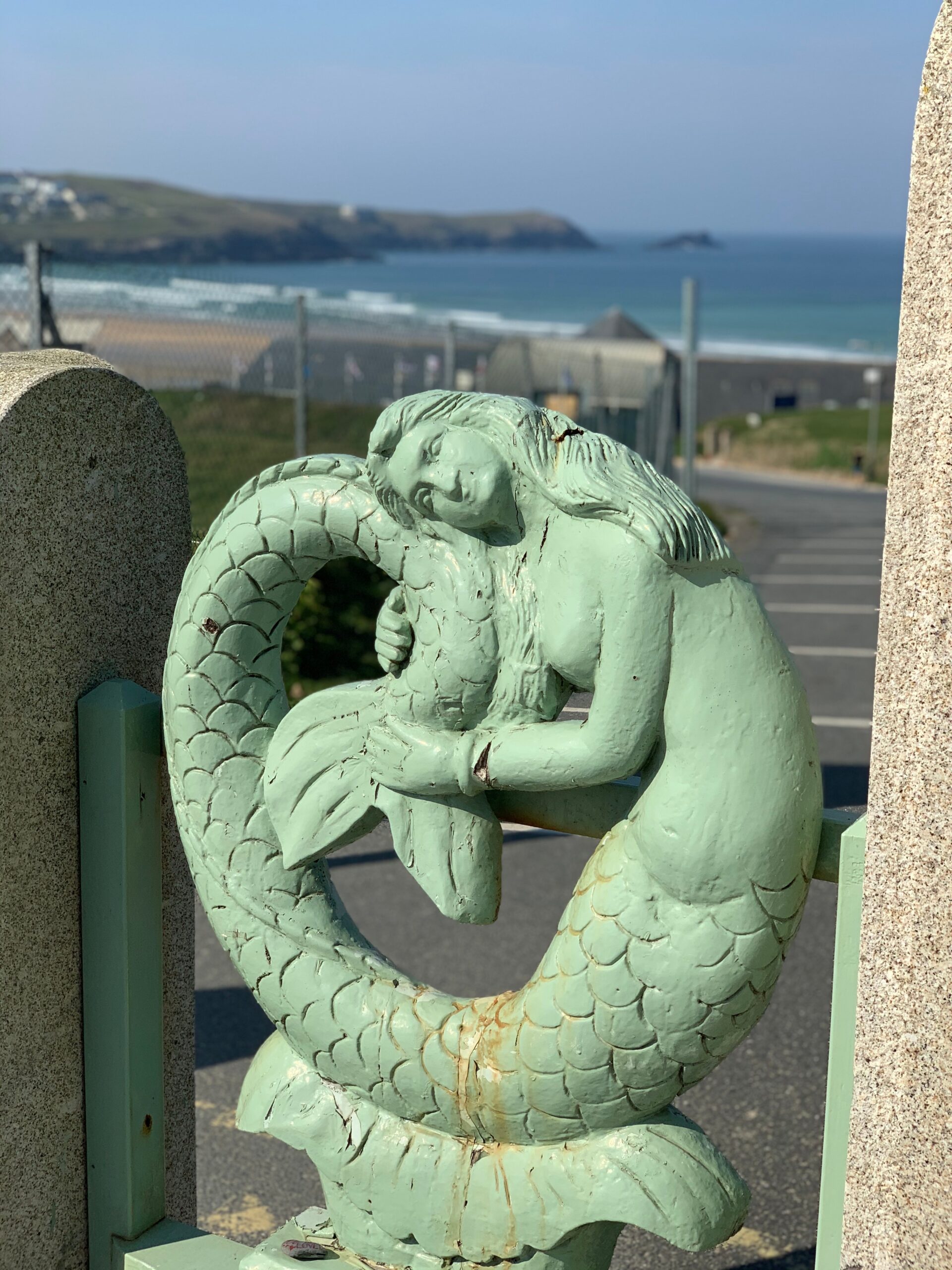
I have been obsessed with mermaids from the time I saw my very first one. I can’t remember if it was in a book or a cartoon, but I wanted to know everything about this incredible creature. Every single acquisitions meeting at work I ask about mermaids. I am a big advocate for them. As I was working on my new look website (launched today on Beltane, yay!), I was looking over an old cache of things I wrote when I was a journalist.
It reminded me how my obsession with mermaids has been with me throughout. I can’t quite believe how I managed to do it, but waaaay back in the day Metro newspaper had the wonderful features editor Kieran Meeke and his deputy James Ellis. These fabulous gents agreed to let me write about mermaids as part of a series on the supernatural (spoiler alert: I wrote a LOT of those features). I have posted the original, unedited article below because it tickled me that I interviewed a marine biologist for it. Keep believing, kids!

It has been suggested that sightings of mermaids may actually be of dugongs, or sea cows, that swim in shallow waters.
Fishermen have long been renowned for tall tales but perhaps the tallest of all is that of mermaids. Mermaid legends are extremely old and have a degree of similarity, irrespective of which country they come from. All depict the creature as half-human, half-fish and sightings are generally said to be ill omens, foretelling bad storms, rough seas and death at sea. In fact, (with the exception of Mami Wata, the West African mermaid goddess) most mermaid stories are of fearsome sirens luring men to their watery graves. It has only been in the 20th century that the mermaid’s reputation got a romantic re-make, with Disney and Hollywood being the main stylists. Older versions of these stories say that mermaids yearn for a soul and that they can only get this by marrying a human, hence their stalker-like behaviour with men.
However not everyone thinks mermaids are out to get us. Carina Coen, founder of holistic therapies company Mercarina, believes she was a mermaid in a past life. She had an unusual experience in her apartment, ‘One night, on the wall behind my head, my handpainted picture of a dolphin and mermaid came to life. It was as though the top part of the whole room became deep sea water, the mermaid floated above me singing and talking with incredible passion.’
This mermaid told Coen that her mission on Earth was to ‘return others to their inner soul life journey’. This she set about doing through her holistic well-being company. The mermaid had more information for her, ‘She reminded me of the need for my own self-communication and taught me a song “Feel The Water” and the coming of infinity in 2008.’ She urged Coen to help awaken people to how we are destroying the seas. Coen agrees that her experience may sound surreal but it was as dramatic to her as a flesh-and-blood sighting.
The last reported sighting was in 1947 when a fisherman from the Isle of Muck in the Highlands said he had seen a mermaid near the shore, sat on a lobster box, combing her hair. However, further research into the story does not bring forth a name for the fisherman or any more details, making it seem like a ‘fisherman’s tale’.
Hoaxes have also dented the idea of mermaids being real. The most famous of these was the Fiji mermaid, purportedly found by Japanese fishermen near the Fiji Islands, and brought to the New York-based American Museum in 1842. This ugly creature was found to be a composite of papier-mache, a baby orangutan, a monkey head and bits of different fish. Such hoaxes have circulated for thousands of years, perhaps the most recent being reports from Chennai after the Indian Ocean tsunami in 2004. The photos of the so-called mermaid turned out to be an older hoax, again using primate and fish parts.
Marine biologist, Dr. Vicki Howe explains why mermaids don’t exist, ‘There are many strands of evolution, of which fish and mammals are just two. Both humans and fish are vertebrates however these are two divergent evolutionary pathways and mammals are warm-blooded whereas fish are cold-blooded. That is a good starting point, I would guess, for refuting the existence of a fish-human hybrid.’
It has been suggested that sightings of mermaids may actually be of dugongs, or sea cows, that swim in shallow waters. ‘It’s nice to think dugongs, that are huge graceful animals with soft smiling faces, could be mistaken for mermaids,’ says Dr. Howe. ‘Sailors on long journeys at sea, working hard with poor diets and plenty of grog, may have resorted to wishful thinking.’ However, just to be on the safe side, any men hearing singing from the sea this summer step away from the shore before you’re a victim of fishy fatal attraction.